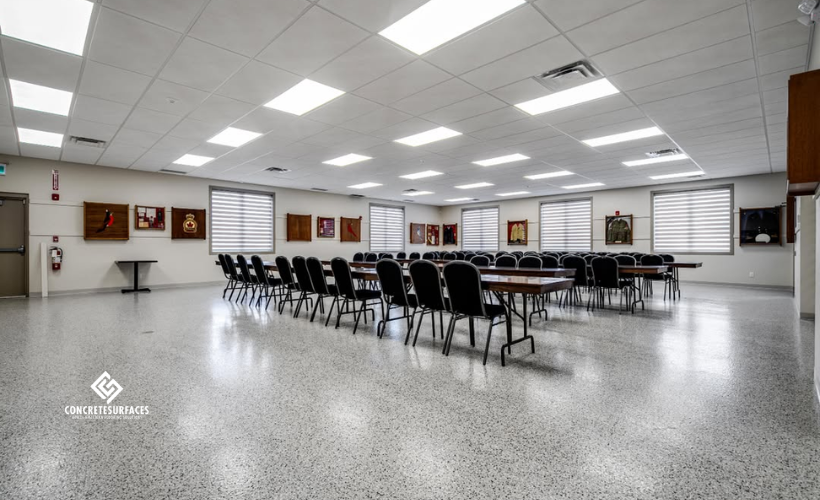
Restaurant floor coatings take more punishment than any other surface in a Windsor-Essex food business. A concrete floor in a working kitchen absorbs boiling dishwasher water, grease from the fryer line, acid from dropped citrus and tomato, and loaded speed racks rolling over it every shift. Bare concrete slabs cannot survive that mix. They stain, dust, and crack at the joints, first in the hottest, wettest corner of the room. Canadian Concrete Surfaces installs seamless, high-performance epoxy floor systems for that environment. The right flooring depends on what happens on each section of your slab.
Why Commercial Kitchen Floors Break Down Faster Than Any Other Surface
A working kitchen attacks its floor from three directions. Heat arrives in waves. Chemicals arrive with every service. Constant foot traffic never stops. Most Windsor-Essex restaurants run on a slab poured decades ago, with control joints never sealed for wet use. Bare concrete is porous. It soaks up liquid like a sponge, so grease and bacteria travel into the slab where scrubbing cannot reach them.
Thermal Shock at the Dish Pit and Fryer Line
Thermal shock is a sudden temperature swing. A fryer station goes from hot oil splash to cold mop water in minutes. Concrete and a standard epoxy coating expand at different rates during that swing, so the bond between them breaks. The failure starts as a blister near a drain, then spreads under heavy traffic until the coating peels off in sheets. A system rated for repeated temperature swings moves with the slab instead.
Food Acids, Grease, and Nightly Sanitation
Tomato, citrus, vinegar, and wine are mild acids that etch unprotected concrete. Animal fats react with alkaline cleaners and leave a slick film. Quaternary sanitizers add another chemical load at closing. Daily wear from cart wheels and dropped pans adds abrasion on top of the chemistry. A concrete coating here has to resist acids, fats, cleaners, and surface wear together. Canadian Concrete Surfaces picks floor systems room by room, so the dish pit never gets the same build as dry storage.
Coating Systems Built for Food Service
Concrete floor coatings for food service fall into three families, and commercial flooring systems are chosen by zone. A dish pit and a dining room twenty feet away have different flooring needs. Matching the flooring solution to each zone controls your cost per square foot.
Urethane Cement for the Cook Line and Dish Pit
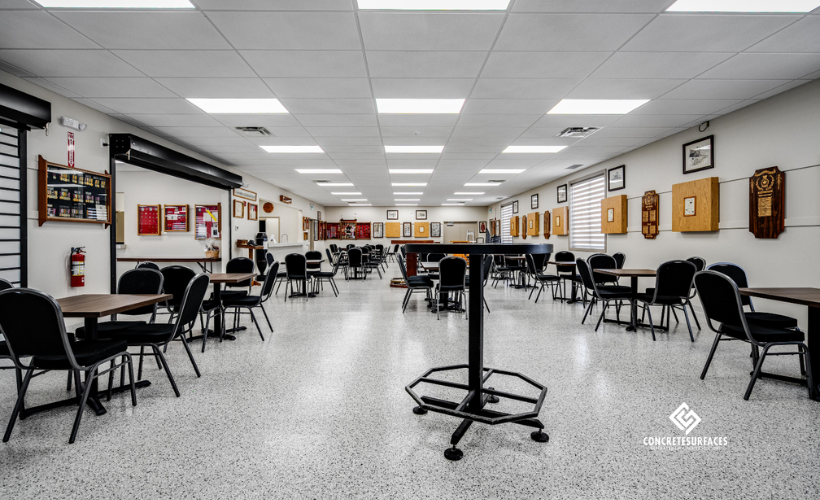
Urethane cement, also called polyurethane mortar, is the commercial grade choice for the hottest and wettest parts of an industrial kitchen. Crews install it at a quarter inch or thicker, so it handles steam cleaning and near-boiling water that destroys a thin film. Mineral filler keeps its expansion rate close to concrete, so the two move together. Anti-slip texture is built into the finish, which matters where grease and water land on the same spot every shift.
100% Solids Epoxy for Prep Areas and Dry Storage
A 100% solids epoxy resin contains no solvent, so it does not shrink as it cures. It forms a thick, seamless epoxy floor with strong chemical resistance and almost no volatile organic compounds during install. This epoxy floor coating fits the zones where most commercial kitchen epoxy work happens: prep rooms, walk-in surrounds, dry storage, and back hallways with moderate heat. A commercial epoxy floor has no grout lines to trap debris, and it is easy to clean with a mop and a neutral cleaner. Broadcast quartz adds a slip-resistant profile in aisles where cooks carry hot pans.
Flake, Metallic, and Polyaspartic Systems for Dining Rooms and Bars
Front-of-house flooring options put appearance first, with traction and low maintenance close behind. Installers broadcast decorative flake into an epoxy base, then seal it with polyaspartic coatings. The result is a durable, colour-matched epoxy floor with light texture. Metallic epoxy is the other choice. Metallic pigments move through the resin as it cures and give a room a marbled look no tile reproduces. Polyaspartic topcoats also cure fast and resist UV yellowing near storefront glass, which protects aesthetic appeal. The best epoxy for a dining room is rarely the right system for a dish pit.
Concrete polishing produces a hard surface with visual depth. Polished concrete flooring suits retail floors, showrooms, and dining rooms on sound slabs. It is not a fit for a wet kitchen, because a polished surface still absorbs grease.
Systems Proven Beyond the Kitchen
Restaurants are one part of a broader commercial and industrial workload. The same epoxy flooring systems that hold up in a kitchen also serve warehouse flooring, industrial floor slabs, and commercial applications such as retail backrooms and service bays. That range matters when you choose epoxy flooring for a restaurant. A contractor used to heavy foot traffic and forklift loads brings the same durability standards to your dining room and covers the flooring applications across your building.
Slip Resistance and Health Inspection Standards
Ontario food premises regulations require floors in food handling areas to be smooth, non-absorbent, and cleanable. Wall junctions must be finished so staff can sanitize them. Windsor-Essex County Health Unit inspectors check those surfaces during routine visits, and a peeling floor becomes a documented issue. A professionally installed resinous floor answers several of those requirements at once.
What inspectors and insurers look for:
- Seamless surface with no grout joints or open cracks that hold food debris
- Cove base, a curved edge where floor meets wall, so mop water cannot get behind the coating
- Floor sloped toward the drains, with the coating carried into and over the drain flange
- Textured finish that keeps its grip when the floor is wet or greasy
- Non-absorbent topcoat that resists stains from acids and sanitizers
Slip resistance protects your staff as much as your inspection record.
Installation Without Closing for a Week
Downtime is the real cost of a new floor. Professional installation on commercial projects across Windsor-Essex runs on a schedule built around service hours, and urethane cement and polyaspartic systems return to service faster than tile.
A restaurant installation usually follows this sequence:
- Inspect the slab, test it for moisture, and check the drains
- Grind or shot blast the concrete so the coating can grip
- Repair cracks, fill low spots, and form the cove base at the walls
- Apply the base coat, the broadcast layer, and the topcoat, zone by zone
- Reset the equipment and reopen once the floor cures
Work often runs overnight or one zone at a time, so the kitchen keeps producing during the rebuild.
Keeping the Floor Performing After Installation
A long-lasting floor depends on cleaning that suits the surface. Texture holds grip, and it holds grease when staff flat mop instead of deck brushing. Strong solvents also break down topcoats. A simple routine often buys ten years before a refresh coat, which is far more cost-effective than a full rebuild.
Daily habits that protect the surface:
- Dust mop or sweep before wet cleaning, so grit does not scratch the topcoat
- Use a neutral or manufacturer-approved cleaner instead of harsh solvents
- Deck brush textured zones to lift grease out of the surface texture
- Flush floor drains often, so water does not sit at the coating edges
Local Conditions That Affect Windsor-Essex Kitchens
Every epoxy flooring Windsor project starts with the slab. Commercial buildings converted from retail to food service often sit on concrete with no vapour barrier. Moisture rises through that slab and lifts coatings never tested for it. Freeze-thaw movement through an Essex County winter widens cracks, and back doors onto a loading area bring road salt inside. Moisture testing separates durable concrete that lasts a decade from a floor that fails in a season. Canadian Concrete Surfaces has worked on slab stock in Windsor, Tecumseh, LaSalle, Leamington, and Amherstburg since 1999, and prices each project against what the concrete needs.
Book a Kitchen Floor Assessment
Restaurant floor coatings protect three things at once: your health inspection record, your staff, and the equipment on that slab. Canadian Concrete Surfaces is owner operated, so the people who quote your commercial concrete floor are the people who install it. We deliver flooring services in Windsor and across Essex County, Chatham-Kent, Sarnia, and Southwestern Ontario, building epoxy flooring solutions for restaurants, commercial kitchens, bakeries, breweries, and food processors.

Call Canadian Concrete Surfaces to book an on-site assessment, and we will recommend the system that matches the heat, chemicals, and traffic in your kitchen.

Devon has over 25 years of experience providing customers with high performance epoxy flooring to fit any need or budget. Referrals are our best friend and customer satisfaction is always our top priority. When Devon is not working you can find him fishing, or hunting across North America.

Share This Article
Choose Your Platform: Facebook Twitter Google Plus Linkedin