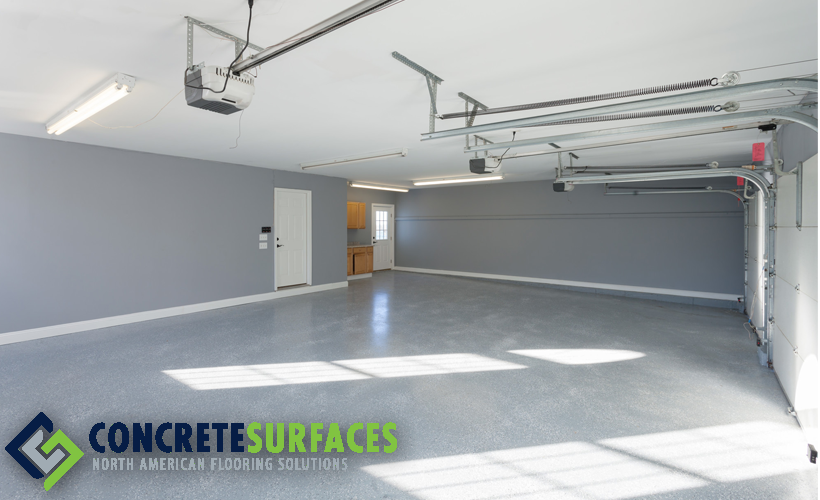
Epoxy flooring systems are among the most trusted flooring options for garages, warehouses, factories, and commercial buildings across Ontario. They belong to a broader category called resinous flooring, and there are many different types to choose from. Each has their own application and use for a different flooring environments. This guide explains all five, covers their benefits, and helps you understand what sets each one apart. Whether you need a durable coating for a residential garage in Windsor or a heavy-duty floor for a factory in Essex County On.
Canadian Concrete Surfaces has been installing epoxy flooring systems for over 25 years.
What Is an Epoxy Flooring System?
Epoxy is a two-part product made of resin and hardener. When these two parts are mixed together, they react chemically and harden into a solid, seamless surface that bonds permanently to standard concrete. The resin chemistry behind this reaction is what gives epoxy its hardness, chemical resistance, and long service life. Mixing errors such as using the wrong ratio or incomplete blending interrupt that reaction and result in a floor that stays soft, peels, or fails early.
The thickness of the coating plays a major role in how well the floor performs. A true epoxy floor contractor knows to apply at a minimum of 2mm, or about 80 mil. Anything thinner than 80 mil is a sealer, not a flooring system. A thicker application provides more impact resistance and a longer lifespan. Once cured, epoxy seals the concrete and blocks moisture, oil, and chemicals from reaching the slab below. Proper surface preparation using diamond grinding or shot blasting is required before any epoxy is applied. Without it, the coating cannot bond correctly and will eventually lift.
The 5 Main Types of Epoxy Flooring Systems
1. Self-Leveling Epoxy
Self-leveling epoxy pours onto the floor and spreads itself flat, creating a smooth and seamless surface. It works well on new concrete and on older slabs that have minor cracks or surface wear. This system is the most common choice for commercial spaces and demanding commercial environments like retail stores, office buildings, and showrooms.
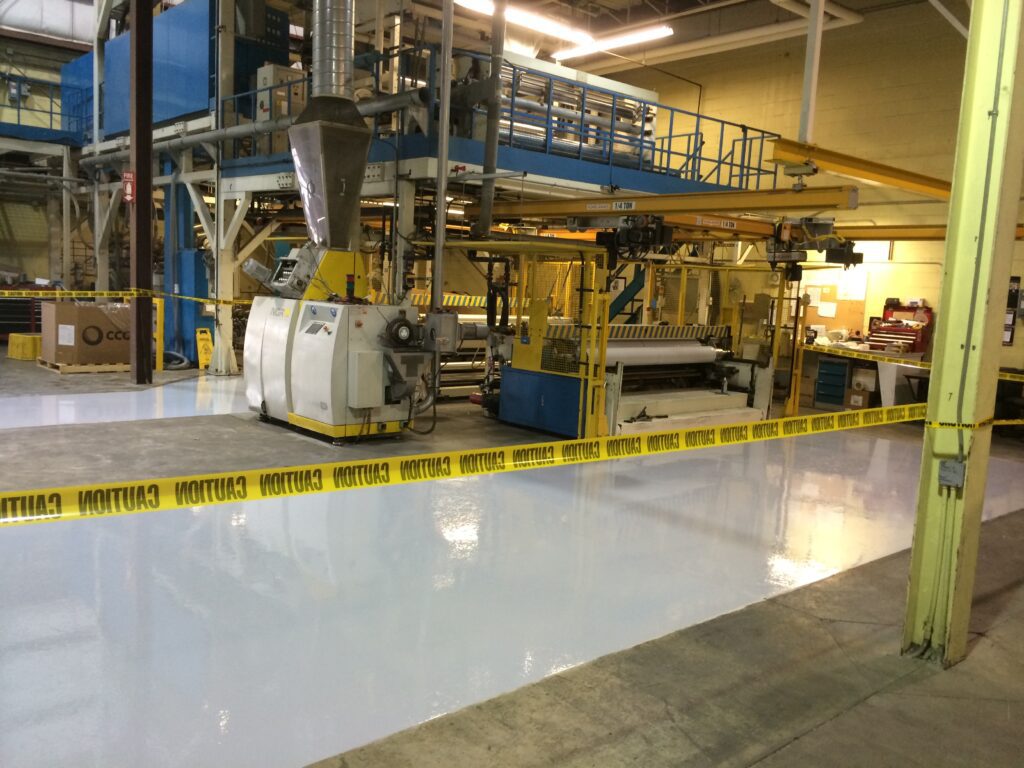
The surface it produces is glossy, easy to maintain, and has excellent ease of cleaning. Spills wipe up quickly and nothing gets trapped in seams or joints. It comes in a wide range of colors and can be combined with decorative flakes for added texture. Using epoxy at this level makes it a practical, cost-effective choice for any space that needs a clean, professional-looking floor. Canadian Concrete Surfaces installs self-leveling systems across Windsor-Essex County for businesses that cannot afford extended downtime during installation.
2. Epoxy Mortar Systems
Epoxy mortar is the toughest system in the epoxy family. It combines epoxy resin with graded sand or quartz to create a thick, hard surface built for industrial facilities and manufacturing plants where floors take a beating every day.
Applied at over 160 mil, this system delivers the strength and durability needed to handle forklift traffic, dropped equipment, and constant exposure to harsh chemicals. It maintains the structural integrity of the concrete below by distributing heavy loads across a reinforced surface layer. The epoxy used in mortar systems is 100% solids… meaning no solvents, no shrinkage, and no fumes lingering after installation. This makes it one of the safest and most reliable choices for high-demand industrial floors.
3. Quartz-Filled Epoxy Systems
Quartz-filled epoxy blends high-strength epoxy resin with colored quartz granules. The granules give the surface natural texture, which improves grip underfoot — even when wet. The result is a floor with strong abrasion resistance and real aesthetic appeal, with a decorative look similar to terrazzo but at a lower cost and with better chemical performance.
Materials like quartz also make the surface non-porous and seamless, which prevents bacteria from growing in cracks or joints. This makes the system a natural fit for commercial kitchens, food processing facilities, healthcare buildings, and school corridors. Facility managers appreciate that it meets strict sanitation standards while still offering a wide range of color options to match their branding or safety markings.
4. Epoxy Flake Systems
Epoxy flake systems use a base coat of epoxy with vinyl color chips scattered across the surface before it cures. A clear protective topcoat is then applied to lock the chips in place. The finished floor is decorative, multi-toned, and built to hide everyday scuffs and dirt. Keeping the epoxy floor looking clean with minimal effort.
The topcoat, usually polyaspartic or urethane is low-maintenance and UV-stable, which means it resists yellowing from sunlight. It is durable enough to keep them looking sharp for years without resealing or re-coating under normal use. This system is the most popular choice Canadian Concrete Surfaces installs for homeowners in Windsor, LaSalle, Tecumseh, and Leamington. A full flake system with a polyaspartic topcoat handles oil spills, hot tire contact, and the freeze-thaw cycles that Ontario winters bring.
5. Anti-Slip Epoxy Systems
Anti-slip epoxy is built for spaces where traction and safety underfoot are a primary concern. Textured additives such as aluminum oxide, quartz sand, or polymer grit are broadcast into the surface coating to create grip that holds even when floors are wet, oily, or heavily trafficked.
The level of texture can be adjusted to match the demands of the environment. A light profile for commercial kitchens and healthcare corridors, or a more aggressive surface for loading docks, ramps, and industrial walkways. Anti-slip epoxy meets workplace safety standards and helps facility owners reduce the risk of slip-and-fall incidents. Applications include food processing plants, car washes, pool decks, warehouses, and any environment where wet or slippery conditions are a regular concern.
Key Benefits of Epoxy Flooring Systems
All five system types share a core set of advantages that explain why epoxy remains one of the most widely used floor coatings in Ontario.
- Strength and durability: Epoxy bonds directly to concrete and holds up under heavy loads, daily foot traffic, and equipment use. Most commercial systems last 10 to 20 years with proper care.
- Lower maintenance costs: The seamless surface does not collect dirt in joints or cracks. Regular sweeping and occasional mopping is all it takes — no waxing, polishing, or resealing required.
- Chemically resistant surface: Epoxy stands up to oils, fuels, cleaning agents, acids, and solvents. Specialty formulations are available for more aggressive chemical environments.
- Abrasion resistance: High-solids epoxy withstands daily surface wear from foot traffic, carts, and wheeled equipment without degrading.
- Concrete can be re-coated: When a concrete floor eventually shows wear, it does not need to be torn out. The floor can be grinded and re-coated directly, avoiding the additional cost of full removal and concrete replacement.
- Safety features: Anti-slip additives, ESD properties, and floor marking lines can all be added to any epoxy system.
Why Surface Preparation Cannot Be Skipped
The floor coating is installed over concrete and the condition of that concrete determines everything. Proper surface preparation clears away dirt, oils, weak surface layers, and anything else that would prevent the epoxy from bonding correctly.
Shot blasting works best for large industrial and commercial floors. Diamond grinding suits smaller areas and precise profiling work. Both methods produce consistent quality results by creating a surface the epoxy can grip at a mechanical level. Moisture is the biggest hidden risk. Concrete that releases moisture vapor after coating will cause the epoxy to bubble, separate, and fail regardless of system quality. Canadian Concrete Surfaces tests every slab for moisture before choosing the right primer and system for each job.
How to Choose the Right Epoxy for Your Floor
To choose the right epoxy, start with four questions: How will the floor be used? How much traffic will it handle? What chemicals will it be exposed to? And what should it look like when finished?
Matching Flooring Type to Application
A garage in Windsor does best with a flake system and polyaspartic topcoat. A food plant in Leamington needs quartz-filled epoxy for sanitation and grip. A production floor in Windsor needs mortar-grade epoxy to handle forklifts and fluid spills. A pharmaceutical lab needs a chemically resistant, conductive epoxy or static-dissipative ESD system matched to its resistance requirements. Getting this flooring type decision right from the start prevents premature failure and unnecessary repair costs.
Get the Epoxy Flooring System That Fits Your Needs
Epoxy flooring is one of the most cost-effective and lower maintenance solutions for protecting concrete in residential, commercial, and industrial settings. The key is matching the right system to the right application and having it installed by a team that knows the difference.
Canadian Concrete Surfaces has delivered consistent quality across Windsor-Essex County, Chatham-Kent, Sarnia, and surrounding Ontario communities since 1999. As a business owner owner that relies on word of mouth referrals, we have an experienced team that provides free estimates for new projects and offer professional installations. Contact Canadian Concrete Surfaces today to find the right epoxy flooring system for your space.

Devon has over 25 years of experience providing customers with high performance epoxy flooring to fit any need or budget. Referrals are our best friend and customer satisfaction is always our top priority. When Devon is not working you can find him fishing, or hunting across North America.
Share This Article
Choose Your Platform: Facebook Twitter Google Plus Linkedin